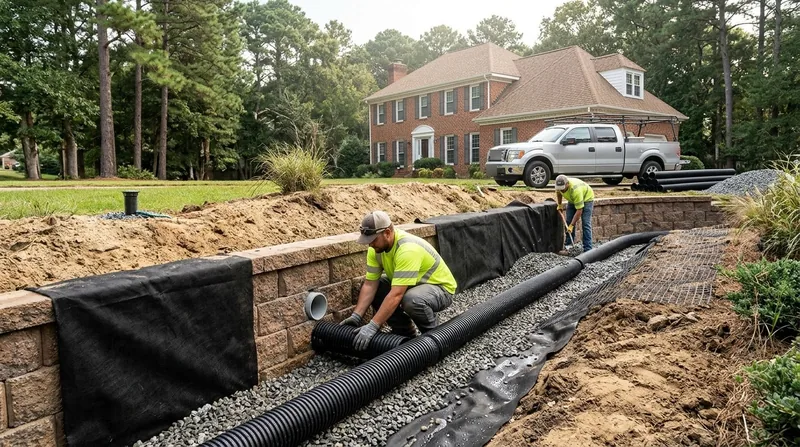




Virginia Beach sits on low, flat Coastal Plain ground where sandy loam and old dune sand rest over soft marine clay, and the water table often sits just a few feet down. That means Retaining Wall Drainage in Virginia Beach is not an add-on, it is the difference between a wall that stands for decades and one that leans after the first nor'easter. Tidal creeks, canals and the Lynnhaven River push into neighborhoods from Great Neck to Thalia, so saturated sand loads every wall from behind. We design French drains, weep holes, gravel backfill and filter fabric that relieve hydrostatic pressure and stop fine sand from washing out. If your wall is already bulging or cracking, start with retaining wall repair before the footing gives way.
Why Drainage Decides Whether a Virginia Beach Wall Survives
Walls here fail from water, not from hills. Hurricane and nor'easter rain soaks the sandy backfill, the water table rises, and hydrostatic pressure pushes against block, concrete and timber alike. In Kempsville and Pembroke, 1960s ranches sit behind rotting railroad tie walls that have no drainage at all, and the first heavy storm season tips them forward. On the North End, cedar-shake cottages on sand lots see washouts undermine footings within a single storm cycle.
- Saturated sand adds hundreds of pounds of pressure per linear foot behind a wall.
- Fine dune sand migrates through joints and clogged fabric until voids open under the footing.
- Tidal flooding in Great Neck and Bay Colony raises the water table for days after a storm.
- Timber and railroad tie walls rot fastest where water stands against the wood.
Every drainage job we run starts by reading how water actually moves across your lot, not by guessing.
Key info: A Great Neck waterfront wall we inspected had a clean face and a dry-looking yard, but the gravel behind it was packed with fine sand and the weep holes were sealed. One more nor'easter would have pushed it over. Drainage fixes are far cheaper than a collapsed wall rebuild.
For the official rules on walls and grading, check the City of Virginia Beach Planning and Building Department before you build or modify a wall near a property line.
How We Install Retaining Wall Drainage in Virginia Beach
We work from the soil up. First we expose the wall face and footing, then we cut out the failed backfill and confirm where the water is coming from. On flat Coastal Plain lots the source is usually the water table and roof or patio runoff, not a hillside. We build the drain so it keeps working through a tidal cycle, not just through a dry week.
- We dig out the saturated sand and old clogged gravel behind the wall.
- We line the excavation with filter fabric so fine sand stays out of the drain.
- We set a perforated French drain pipe at the footing with a positive slope to daylight or a sump.
- We backfill with washed gravel and wrap the fabric over the top.
- We core clean weep holes through block and concrete walls at the low spots.
- We tie downspouts and patio runoff into the system so water never dumps behind the wall.
- We test the drain with a hose before we backfill the last lift.
If the wall is already leaning, we stabilize it before we touch the drainage, because a drain will not save a footing that has already rotated.
Key info: In Thalia we rebuilt the drainage behind a 30-foot block wall on a split-level lot. The original builder used sand backfill and no pipe. We added a French drain, gravel, fabric and four weep holes, and the wall has stayed plumb through two hurricane seasons.
If your wall sits on a slope above a tidal creek, pair drainage with slope stabilization and erosion control so the whole bank holds.
Drainage Approaches We Use on Virginia Beach Walls
Not every wall needs the same system. A poured concrete wall on a pool deck in Pembroke behaves differently from a railroad tie wall holding a sand bank in Kempsville. We match the approach to the wall type, the water table and how much runoff the lot sends toward the wall.
| Approach | Description | Best for |
|---|---|---|
| French drain behind wall | Perforated pipe at the footing in washed gravel, wrapped in filter fabric. | Block, concrete and timber walls on flat lots with a high water table. |
| Weep holes and gravel backfill | Cored outlets through the wall face with clean gravel behind them. | Poured concrete walls and older masonry that trap water. |
| Filter fabric and drainage stone | Fabric separation that keeps fine dune sand out of the drain. | Sandy loam lots where fines clog pipes within a few seasons. |
| Surface and downspout control | Regrading, swales and downspout tie-ins that move runoff away. | Patios and pool decks in Great Neck and Bay Colony. |
| Sump and pump discharge | A collection point that lifts water out where gravity will not. | Lots near tidal creeks where the outlet floods at high tide. |
We pick the lightest system that solves the water problem, then we stand behind it.
Retaining Wall Drainage Cost in Virginia Beach: What to Expect
Most drainage work starts at From $2,500 and climbs with wall length, wall height and how much saturated backfill has to come out. A short timber wall in Kempsville with a simple French drain sits near the low end. A tall tiered block wall on a waterfront bluff in Bay Colony, where access is tight and the outlet has to fight the tide, runs well above it. We quote after we see the wall and the water, not from a phone description.
- Wall length and height drive how much pipe, gravel and fabric the job needs.
- Access matters: a wall behind a pool deck or tight side yard costs more to dig.
- Wall type changes the work, since cored weep holes in concrete cost more than gravel behind timber.
- Proximity to tidal creeks can force a sump and pump instead of a gravity outlet.
- Urgency counts, because a wall already leaning needs stabilization before drainage.
Get two or three estimates and compare what is actually included, because a low number that skips filter fabric will cost you again in three years. Our full pricing overview breaks down the ranges by wall type and scope.
Retaining Wall Drainage Near Me: How to Vet a Contractor Near Virginia Beach
When you search for retaining wall drainage near me, you get a long list of names and very little proof. Drainage is invisible once it is buried, so the contractor's habits matter more than the sales pitch. Ask direct questions and check the answers before anyone digs.
- Confirm the company is fully insured in Virginia and ask for a certificate.
- Get at least two or three written estimates with the drain design spelled out.
- Ask for references from walls like yours, especially block or concrete walls on tidal lots.
- Check whether a permit is needed, since many jurisdictions require one above roughly 4 feet or when the wall carries a surcharge, and always confirm with the local building department.
- Ask how they handle HOA rules on setbacks and visible wall changes.
If a contractor cannot explain where the water will go, keep looking. You can reach us through our contact and free estimate page to schedule a site visit.
Retaining Wall Drainage in Virginia Beach: Pricing Guide
| Service | Price | Details |
|---|---|---|
| French drain behind existing wall | Starting at $2,500 | Includes excavation, filter fabric, perforated pipe and washed gravel for a short wall. |
| Weep holes and gravel backfill | Starting at $2,800 | Cored outlets through block or concrete plus clean gravel, priced by wall length. |
| Full drainage rebuild on tall or tiered wall | On estimate | Tall walls and tight access need an on-site look before a number is given. |
| Travel | Included | in Virginia Beach and surrounding areas, no separate call-out or mileage fee |
| Estimate | Free | Response within 24h at (757) 579-1955, no obligation to book |
Indicative pricing, the exact cost depends on square footage, finish, and site access. Free personalized estimate within 24h at (757) 579-1955.


